
Barn Wedding Design in Maine: How to Make It Feel Refined, Not Rustic | Maine Event Design & Decor
Barn Wedding Design in Maine:
How to Make It Feel Refined, Not Rustic
"Barn wedding" is one of the most searched phrases in Maine wedding planning — and one of the most misunderstood. Most couples picture the same handful of images: mason jars, burlap runners, string lights hung without a plan. That aesthetic has a name, and it is rustic. It is not, on its own, refined. It is not, on its own, luxury.
I'm Robyn Weathers, and for over 35 years I've designed weddings inside Maine's most beautiful barns — Flanagan Farm, Hardy Farm, Garden Gate at Haley Farm, and dozens more. What I've learned, installation after installation, is that a barn is not a style. It is a structure. What happens inside it — the lighting, the draping, the florals, the way every layer is considered — is what determines whether your wedding reads as rustic-by-default or refined-on-purpose.
This guide walks through exactly how we make that shift for our couples. If you're planning a Maine barn wedding and want it to feel elevated rather than expected, this is the thinking behind every design decision we make. You can also see the results in our full gallery or explore our design services.
Why "Rustic" Undersells Your Barn
Every barn in Maine already has character built in — hand-hewn timber framing, decades of weathered wood, ceiling heights that most modern venues can't replicate. The mistake many couples make is decorating toward that raw character instead of designing above it. Mason jars and burlap don't add to a beautiful barn. They flatten it into a theme, when the barn itself already gives you something far more valuable: architecture.
Refined barn design treats the structure as a backdrop for elevated layers, not the aesthetic itself. That means every element you add should raise the room, not decorate around what's already rustic by nature. This is the same principle that separates a styled shoot from a truly designed wedding — intention at every layer, not decoration for its own sake.
The barns we return to again and again — Flanagan Farm's 40-foot timber ceilings, Hardy Farm's sailcloth luminosity, Garden Gate's working flower fields — all share one thing. Their character is strongest when the design responds to it rather than repeats it.
The Four Layers That Elevate Any Barn
Lighting as Architecture

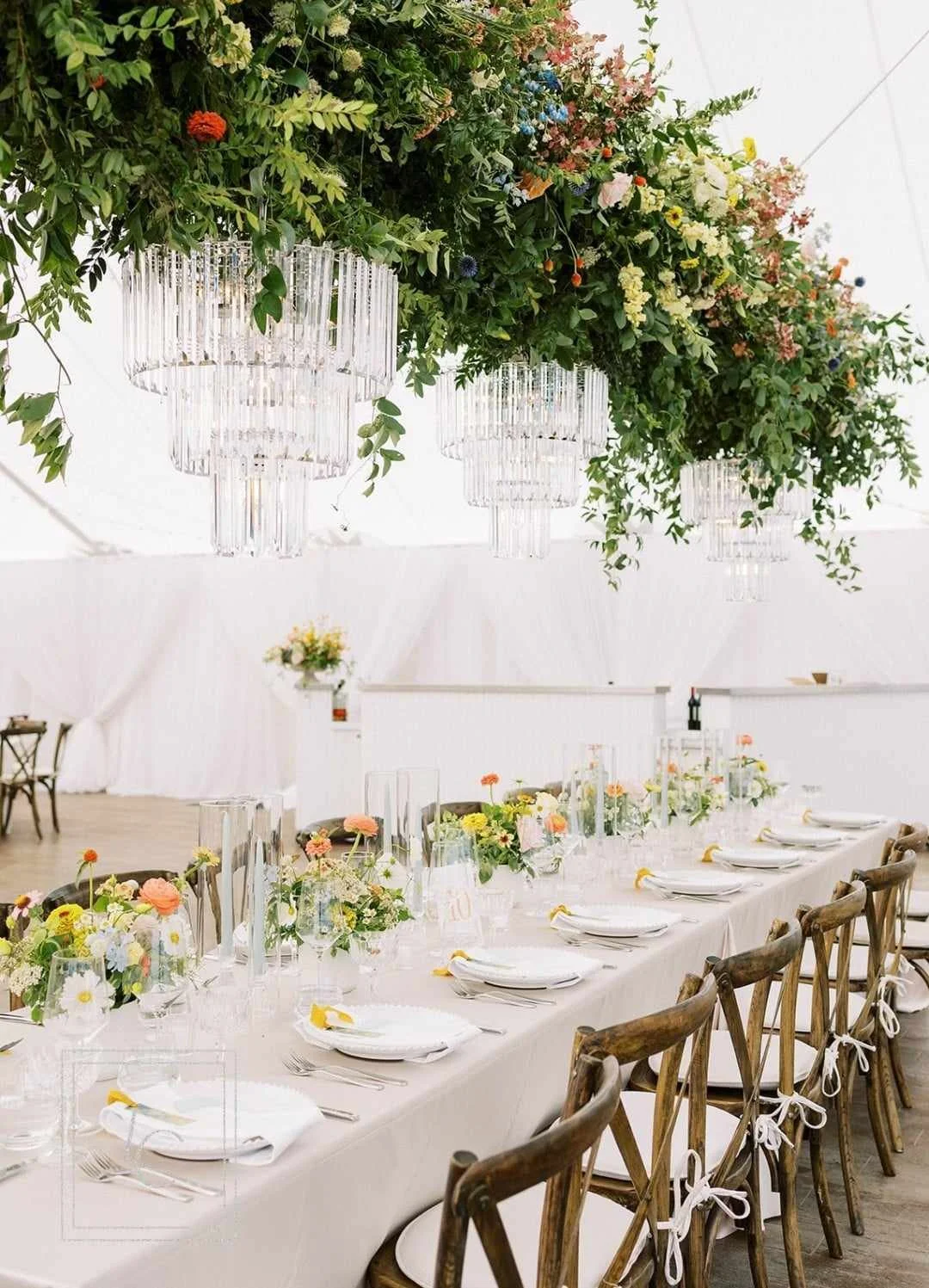
Nothing changes a barn faster than what happens overhead. Flat, single-source lighting leaves a beautiful ceiling looking exactly like what it is — a barn. Layered lighting, by contrast, uses the architecture as a canvas: a golden canopy that draws the eye upward, chandeliers as focal points over the dance floor, uplighting on the timber frame that reveals depth most guests never notice in daylight.
This is the difference between lighting that decorates and lighting that transforms. One adds string lights because barns "need" them. The other designs a lighting plan specific to that barn's height, its beam spacing, and the mood the couple wants at 9pm versus 6pm.
- Layered sources — canopy, chandelier, and uplighting working together, not one string of lights alone
- Warm colour temperature (2700K) used with intention, not just because "warm feels cozy"
- Chandeliers or disco installations as focal points, not filler
- Lighting designed to change the room's mood from ceremony to reception
Draping That Softens Scale
Large barns can feel cavernous once filled with 150 guests and long tables. Draping solves this — not by covering the wood, but by softening scale and creating intimacy within a large volume. Fabric moving gently overhead or framing a ceremony backdrop does something raw wood alone cannot: it introduces movement, warmth, and a sense that the space was designed for this exact wedding, not simply rented for the day.
The refined approach uses draping sparingly and purposefully — one strong installation over the ceremony or head table, rather than fabric everywhere. Less, placed with intention, reads as luxury. Fabric everywhere reads as an attempt to hide the barn rather than elevate it.
Florals That Complement, Not Compete
Weathered wood has warm, earthy undertones. Florals that fight this — overly bright, saturated colour palettes — create visual tension instead of harmony. Refined floral design for a barn leans into the wood's natural palette: warm neutrals, soft greens, dusty tones, with one or two intentional colour moments rather than an explosion of every colour available.
Scale matters here too. A barn's height and volume can swallow small, delicate arrangements. Refined design accounts for this with fuller, more architectural floral moments — an oversized arch, cascading centerpieces, or greenery integrated directly into the lighting installation overhead — so the florals hold their own against the space rather than disappearing into it.
Layout as Guest Experience
Refined weddings feel effortless to guests because the flow was considered in advance — where the ceremony happens relative to cocktail hour, how guests move into the reception, where the eye lands first when they walk in. Rustic barn weddings often skip this step entirely, treating layout as an afterthought once decor is chosen.
We design layout first, then build lighting, draping, and florals around it — because a beautifully lit barn with a confusing guest flow still feels unfinished. The couples who report their wedding felt "effortless" are almost always the ones where we spent the most time on layout before a single light was hung.
- Sightlines from every guest seat to the head table and dance floor
- A clear, intentional path from ceremony to cocktail hour to reception
- Where guests' eyes land first walking in — usually the overhead lighting or a floral focal point
- How the space transforms between ceremony and reception without guests noticing the work
Rustic vs. Refined, Side by Side
The clearest way to see the difference is to compare the two approaches directly. Neither uses different materials, necessarily — the difference is almost entirely in intention and layering.
- Single string light layer, no chandelier or focal point
- Mason jars and burlap as the primary aesthetic statement
- Fabric draping used everywhere, or not at all
- Florals in bright, mismatched tones fighting the wood
- Layout decided the week of the wedding
- Layered lighting — canopy, chandelier, and uplighting working together
- Architecture treated as the backdrop, not covered by theme decor
- One intentional draping installation, placed for maximum impact
- Florals in a curated palette that complements the wood's natural tone
- Layout designed first, before any decor decisions are made
Frequently Asked Questions
Yes. Luxury is not about eliminating the barn's character — it is about designing every layer above it with intention. Lighting, draping, florals, and layout are what separate a barn that has been decorated from a barn that has been designed. The venue provides the bones. The design provides the feeling.
Rustic decor leans on raw wood, mason jars, and burlap as the aesthetic itself. Refined barn decor uses the barn's architecture — timber framing, exposed beams, height — as a backdrop for elevated layers: crystal or Edison chandeliers, layered draping, curated florals, and warm, intentional lighting that transforms rather than decorates.
It depends on the barn's size, ceiling height, and how many design layers you want — lighting alone, or lighting plus draping plus florals. Most couples elevating a full barn reception invest between $4,000 and $12,000+ in design. We build every proposal around your specific space and vision rather than a fixed package.
No. While we have designed dozens of installations at venues like Flanagan Farm, Hardy Farm, and Garden Gate at Haley Farm, we regularly take on new barns across Maine and New Hampshire. We conduct a site assessment before designing anything new, checking ceiling height, rigging points, and natural light.
Avoid over-relying on generic rustic signifiers — mismatched mason jars, burlap runners, string lights with no layering. These read as budget rather than intentional. Instead, choose fewer, more considered elements: one strong overhead lighting layer, one textile layer, and floral or greenery that complements rather than competes.
Your barn deserves more than decoration
Tell us your venue and your vision. We'll show you exactly how we'd elevate it — with lighting, draping, and florals designed specifically for your space, not a template.
Request A Consultation